Scientist Spotlight: Dr. Jeffrey Chamberlain
We are thrilled to feature a researcher spotlight on Dr. Jeffrey Chamberlain, Professor of Neurology, Biochemistry, and Medicine at the University of Washington, and the Director of the Wellstone Muscular Dystrophy Center in Seattle. Widely recognized as a true pioneer in the field of gene therapy, Dr. Chamberlain has spent over three decades pushing the molecular boundaries of myology. From engineering the groundbreaking concept of “micro-dystrophin” in 1996 to unlocking whole-body systemic AAV delivery in 2004, his structural and translational breakthroughs have directly shaped the modern landscape of clinical trials for muscular dystrophies.
When asked to reflect on his thirty-year career, Dr. Jeffrey Chamberlain bypasses abstract theories to focus on three practical milestones that shaped the evolution of muscle gene therapy:
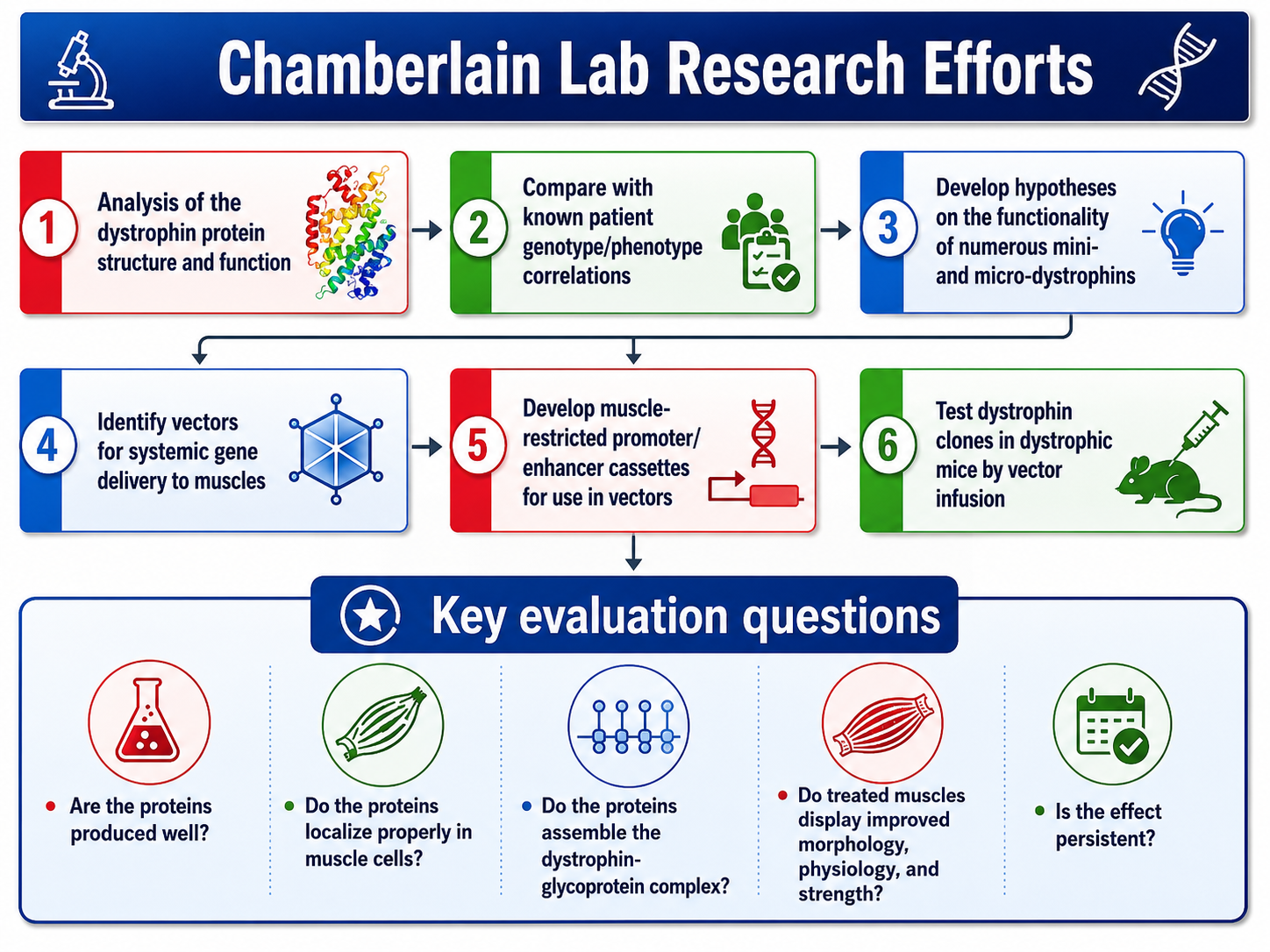
- Decoding the Muscle Promoter (MCK): Early in his career, Dr. Chamberlain successfully cloned the gene for the muscle isoform of creatine kinase (MCK). By mapping its promoter and enhancer elements, his lab engineered highly specific expression cassettes. Today, these exact regulatory elements are driving targeted gene expression in the vast majority of ongoing muscle gene therapy clinical trials.
- Engineering the “Micro-dystrophin” Concept: The massive size of the human dystrophin gene (~2.2 Mb) made it impossible to package into standard delivery vectors. By systematically mapping the structural domains of the protein, his team pioneered the creation of highly truncated, functional “micro-dystrophins” under 4.5 kb. There are currently at least seven biotech companies conducting or preparing clinical trials using this foundational concept.
- Unlocking Whole-Body Systemic AAV Delivery: For years, a massive bottleneck in the field was spatial: how do you deliver a therapeutic gene to every muscle group in a living mammal? Dr. Chamberlain’s lab discovered that specific adeno-associated virus (AAV) serotypes, when delivered intravascularly at high doses, could successfully cross the capillary barrier to target all skeletal and cardiac muscles in vivo.
Confronting the Realities and Future of Gene Therapy
Pauline Garcia: In the past, there was a lot of skepticism about gene therapy, which has shifted dramatically now that we are in the clinic. How do you view the community’s vision today, especially regarding what we see in patients versus animal models?
Dr. Chamberlain: It depends a bit on who you talk to. We used to hear that it would never work or was a waste of time but there are fewer of those people now. But what we are seeing in the clinic right now is that gene replacement is not as effective as a lot of people, including myself, thought it would be.
When you go into the clinic and you don’t have a cure like you do in a mouse, you get two camps. One camp says, “See, it doesn’t work, give up.” My approach to science has always been that you identify problems, and then you solve them. If you look at the amount of dystrophin being made in patients in these clinical trials, and you look at mouse models that have similarly low levels of gene transfer, well, the mice aren’t cured either!
There are really three major issues we need to solve moving forward:
- Delivery Efficiency: The efficiency of gene delivery is simply lower in human patients than it is in animal models.
- Dose-Limiting Toxicity: We cannot just double or triple the current AAV doses to get more protein because we run into critical safety and immune response barriers. We need better vectors and promoters to get more protein expression out of safer, lower doses.
- Functional Limitations of Micro-dystrophin: Micro-dystrophins are highly functional but not perfect. My lab recently published a method combining multiple AAV vectors via a split-vector approach to allow them to come together and express larger, more potent dystrophins inside the cell. We’ve shown in mice that these larger proteins are significantly more effective, particularly in older animals with a more severe phenotype.
To tackle these challenges, Dr. Chamberlain’s lab continues to work on both sides of the equation, optimizing both the cargo and the delivery vehicle. On the cargo side, they are constantly searching for the optimal dystrophin structure, aiming for full-length expression if possible, or engineering the most potent truncated versions. On the delivery side, they are heavily focused on developing next-generation AAV vectors and muscle-specific promoter elements to maximize expression while avoiding toxicity. While his own team leaves non-viral platforms like lipid nanoparticles to other groups, he remains highly eager to see how those emerging systems evolve to complement the field’s efforts.
Concepts the Field Needs to Rethink
Pauline Garcia: Looking at where the field stands today, is there a fundamental concept in gene therapy that you think the community needs to radically rethink?
Dr. Chamberlain: The most fundamental challenge is one that has been there since the very first trials around 1990: delivering genes safely. The immune response has always been, and remains, the primary barrier to any kind of successful gene therapy. We still need a much deeper understanding of how to control it.
But beyond the immunology, the concept we really need to rethink is the timing of intervention and the age of the patient. Ideally, you want to treat any patient at any age. Right now, most clinical trials target children between 4 and 12 years old. This is largely due to the concern that in older patients, the sheer volume of muscle mass already lost becomes irreversible. To be completely honest, I am not sure any of us fully appreciated the weight of that reality at the beginning of this journey.
Pauline Garcia: How is that realization shifting the mindset of clinicians and researchers right now?
Dr. Chamberlain: We are seeing a major shift toward treating individuals as young as possible. The goal is moving from trying to reverse deep structural damage to preventing the disease from taking hold in the first place. Now, realistically, we are always going to have a greater, cleaner impact on younger patients. But that doesn’t mean we abandon older patients who are already living with advanced disease. What it does mean, however, is admitting that simply replacing a gene in a patient who has already lost 80% of their muscle mass is not going to be a cure.
Pauline Garcia: If gene replacement alone isn’t enough for advanced stages, what is the path forward?
Dr. Chamberlain: We have to accept that even for monogenic disorders, gene therapy is only part of the solution. We need to move toward combinatorial therapies, exactly like how we treat cancer. Moving forward, we must couple gene replacement with distinct strategies designed to enhance muscle mass, aggressively reduce inflammation, and combat fibrosis. Overcoming advanced muscular dystrophy will require a multi-pronged therapeutic blueprint, not a single magic bullet.
To truly optimize these combinatorial strategies, Dr. Chamberlain emphasizes that muscle stem cells must become a central pillar of the therapeutic equation. While stem cell transplantation has been actively pursued since the late 1980s, it has long been bottlenecked by the exact same challenge plaguing viral vectors : systemic delivery efficiency. However, as our understanding of stem cell isolation and delivery mechanics matures, a parallel and potentially simpler strategy is emerging : therapeutic modulation of the patient’s existing resident stem cells.
In a dystrophic muscle, endogenous stem cells are heavily suppressed by a hostile environment characterized by intense fibrosis, chronic inflammation, and inhibitory cytokines. Therefore, rescuing or activating these cells cannot happen in a vacuum. Dr. Chamberlain argues that by coupling targeted gene replacement with anti-fibrotic and anti-inflammatory therapies, researchers can effectively ‘clean up’ the niche. Reversing this localized cellular stress naturally restores the regenerative capacity of the host stem cells, allowing them to participate actively in long-term tissue maintenance and recovery.
Mentoring the Next Generation of Myologists
Pauline Garcia: Since our community and the readers of this article includes early-career researchers, PhD students, and postdocs, what is your core philosophy when mentoring trainees who want to succeed in this field?
Dr. Chamberlain: First, you need to build a broad base of knowledge regarding the current state of the art. Be deeply aware of what has already been done, what worked, and what didn’t, that is always your starting place. Second, I encourage people to be bold and think big. Do not be afraid of problems that seem insurmountable, because problems are meant to be solved; that is exactly what science is all about.
At the same time, you have to be realistic about establishing your career. In my own laboratory, I advise trainees to counterbalance risk by managing two projects simultaneously. Pick one highly impactful, high-risk project that could truly move the needle, but pair it with a second, “safer” project. That safer project ensures you get the publications you need to get your foot in the door, build a reputation, and secure your next role.
Pauline Garcia: Networking and stepping out of the lab can be incredibly intimidating when you are just starting out. How important is the community aspect to a young scientist’s career?
Dr. Chamberlain: It is vital. I always emphasize how important it is to get out to meetings and conferences. I know it is easier said than done ; travel is expensive, and it takes time away from the bench. But getting out there to meet people, see what they are working on, making friends, and establishing collaborations is critical for long-term career development.
It is incredibly tough for young people at first. They often feel, “Oh my god, I don’t know anyone here, all these senior scientists already know each other, and they won’t want to talk to me.” But you have to remember that everybody started from that exact same place. You would be surprised: if you just focus on meeting your fellow graduate students and postdocs at these events, before you know it, those exact peers will become the next leaders of the field alongside you. You just have to be a little patient and do your best.
When looking toward the next decade, Dr. Chamberlain mentions that the most impactful breakthroughs will likely emerge from overcoming the stubborn barriers still facing delivery efficiency and pathology. While adeno-associated virus (AAV) vectors dominate current clinical pipelines, the field’s massive pivot toward AAV has inadvertently slowed innovation in alternative delivery platforms. He sees a major opportunity for young researchers to look beyond the current status quo, both by developing entirely new viral vector backbones and by aggressively refining non-viral systems, such as lipid nanoparticles, to achieve the payload capacity and efficiency required for robust muscle targeting.
Concurrently, cellular and regenerative therapies remain highly potent axes for the next generation to advance. Whether through enhancing the activity of resident muscle stem cells or solving the long-standing hurdle of a systemic, whole-body infusion of myogenic stem cells, restoring regenerative capacity is critical.
However, Dr. Chamberlain notes that any future technology must address a stark clinical reality: the heart. While skeletal muscle regeneration relies heavily on satellite cells, cardiac tissue lacks a clear counterpart. If a therapy successfully rescues every skeletal muscle in the body but fails to address the unique pathophysiological demands of the myocardium, patients will still succumb to cardiac failure. For the next generation of myologists, true therapeutic success will require an integrated, whole-body approach that treats skeletal and cardiac muscle as two distinct, yet equally vital, halves of the same equation.
Pauline Garcia: To close out our conversation, you have been a foundational pioneer in this field for decades, navigating all its clinical ups and downs. How have you managed to maintain your patience, your drive, and that fundamental fire for science after all these years?
Dr. Chamberlain: You know, it really comes down to the families and the patients. When you meet the individuals and the families who are affected by these devastating diseases, it completely reframes your perspective. You realize that any frustrations we face in the lab, or any patience required to get through a slow funding cycle, is absolutely nothing compared to what they go through every single day.
Seeing their resilience is what keeps the fire alive. It reminds you exactly why you walk into the lab each morning. Gene therapy is a long, challenging journey, but knowing that the work we are doing has the potential to fundamentally change human lives is all the motivation you will ever need to keep pushing forward.
What makes Dr. Chamberlain so inspiring isn’t just his track record; it’s his mindset. He is completely honest about the clinical hurdles, but he faces them head-on without hesitating. For those of us currently navigating the early stages of our research careers, his resilient, problem-solving energy is exactly the kind of fire we need to keep alive in our own labs.