Scientist Spotlight: Dr. Brendan Evano
Muscle stem cells, also known as satellite cells, are the tissue-resident source of skeletal muscle growth and regeneration through life. Discovered more than six decades ago, much of our understanding of the dynamics of these stem cells and their niche interactions has come from ex vivo systems or analyses of static in vivo images. Developing innovative tools and approaches to study satellite cells in their native environment, Dr. Brendan Evano from the Pasteur Institute, France, asks a simple question: “can we see these dynamics actually taking place, live?”
Dr. Evano received all his academic training in France, completing his PhD at the Journot Laboratory in Montpellier, where he focused on parental genomic imprinting. Dr. Evano then sought to bring his interest in epigenetics and stem cells into an in-vivo context, leading him to the lab of Prof. Shahragim Tajbakhsh at the Pasteur institute in Paris. Today, he serves as one of three permanent scientists in the Tajbakhsh lab, leading his own subgroup dedicated to understanding asymmetric cell division during adult muscle regeneration.
During his postdoc, Dr. Evano explored the inheritance of histone variants during asymmetric cell division, citing findings in Drosophila as an inspiration and suggesting that asymmetrical distribution of histones could be an evolutionarily conserved mechanism of cell fate regulation. Another project, in collaboration with UK-based researchers, focused on profiling muscle stem cells of different muscle types, characterizing their adaption to new environments following transplantation.
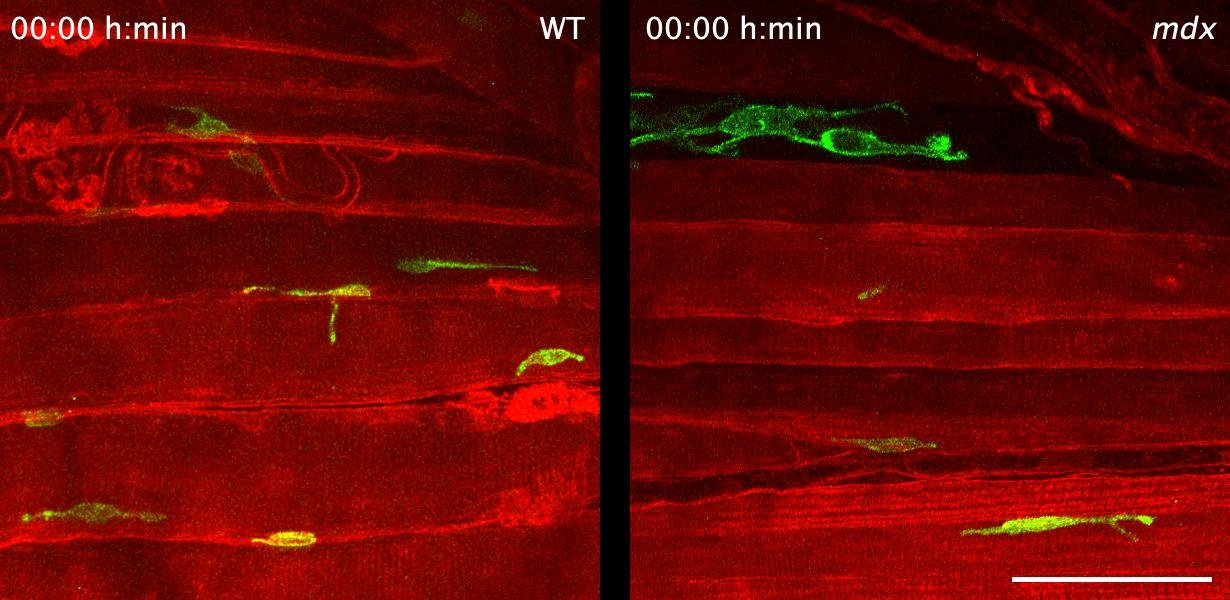
Dr. Evano’s current research philosophy is rooted in development of new tools. By identifying gaps in both knowledge and methodology, his work tackles not only unanswered questions, but does so by means not previously available. Declaring himself a “big fan of in vivo stuff” Dr. Evano believes that seeing a process firsthand provides a level of certainty that computational inferences cannot match. During the COVID pandemic, he utilized the quiet period to refine intravital imaging techniques for skeletal muscles. Smiling, Dr. Evano shares that, “The motivation at first was to do super nice movies of the beautiful muscle stem cells in vivo, the questions to ask came pretty rapidly later”. This effort resulted in the ability to film muscle regeneration continuously for 24 to 30 hours in vivo, capturing the “massive crisis” of an injury: the infiltration, migration, and division, watching as the cells proliferated, fused, and elongated to return to a well-organized structure. Dr. Evano and his team have also used their new visual capabilities to study muscle stem cell division in a mouse model of Duchenne Muscular Dystrophy (DMD), providing the first dynamic analysis of dystrophic muscle stem cell properties in vivo.
Looking Ahead
With his eyes set on our field’s future, we asked him what overarching question he aims at in his future research, Dr. Evano relayed his fascination with the “transition from chaos to order”: how a chaotic, disorganized injured tissue integrates dynamic signals from stromal, immune, and stem cells to return to a state of quiet, structural perfection. Using his lab’s finely tuned tools together with newly developed ones, Dr. Evano hopes to expand his scope beyond the muscle stem cell, exploring dynamic fate decisions and stem cell interactions with stromal cells in vivo in health and how these might be perturbed in a disease context.
Mentoring the Next Generation of Myologists
Lavi Coren: Looking back at your career, what was the biggest challenge you faced? What did you learn from it?
Dr. Evano: My PI told me early on that if you only plan for a three-year postdoc, you end up doing “small stuff”. He encouraged me to go for the “high-hanging fruits” and high-risk projects. However, the uncertainty of short-term contracts during a long postdoc was tough while maintaining high ambitions. At one point near the end, I was actually unemployed for six months while I had two papers in revision.
Looking back 14 years later, I still agree with going for ambitious, high-risk work, but I would offer one caveat: balance your portfolio. If I had to do it again, I would design one risky project alongside a “bread and butter” project. I only had risky projects, and while it worked out, I faced six months of unemployment at the end while my papers were in revision, which was very tough.
Lavi Coren: What advice would you give to a trainee just entering the muscle field today?
Dr. Evano: I have two, the first one is short. You must master coding, handling transcriptomics data and fundamental data analysis; it’s every biologist’s basic toolkit now.
Second, bring something unique. Develop a tool or master a technique that is not common in our field so you can be uniquely identified by your work. That opens doors for collaborations and makes you stand out. The tool should never be developed just for the beauty of the tool; it must address a specific question. However, if you develop a tool that other people want to use, like a specific reporter or knockout, it will be cited and help you set up a professional network. For example, the intravital imaging we developed has opened doors for us far beyond the original papers because people now seek us out for that expertise.
Lavi Coren: What is the most difficult transition when moving from a trainee to a permanent scientist or supervisor?
Dr. Evano: The biggest shift is learning to delegate. As a postdoc, you are responsible for every detail of the project. As a supervisor, you have to hand over the “torch” and accept that people will do things differently than you would. You have to transition from doing everything at the bench to managing people and helping them fix “bugs” in their own experiments.
Lavi Coren: How do you handle the frequent technical failures that come with high-risk research?
Dr. Evano: You learn to enjoy the struggle. Science is a passion, and I actually find fixing bugs and developing methods very rewarding. It can be harder for PhD students because they are on a strict three-to-four-year timeline, and spending a year and a half on a tool that isn’t working feels like forever. But my experience has been that if you spend enough time on a problem, it almost always ends up working—or at least you develop other helpful solutions along the way.
Lavi Coren: On a more personal note, what do you do to recharge outside of the lab?
Dr. Evano: I spend a lot of time with my family and I enjoy biking, though the weather in Paris hasn’t been great for that lately. But honestly, science is a passion.
Lavi Coren: Finally, what aspect of being a scientist continues to excite you most today?
Dr. Evano: For me, being a scientist is a passion by itself. I get excited by solving problems, discussing new ideas, and finding new things. I also get excited about our intravital imaging movies. Seeing stem cells proliferating, fusing, and muscle fibers elongating in real time. We’ve seen it happen countless times in the dish and we know it happens in-vivo, but seeing it with my own eyes is very exciting.
Although now that I am more of a supervisor, I’m not at the bench as much, except to do the “boring” or “too risky” experiments that the students don’t want to do. Yet it is a very rewarding transition to see my students take autonomy over the projects I started and carry them to fruition, taking a step back and watching as the next generation carries the torch.